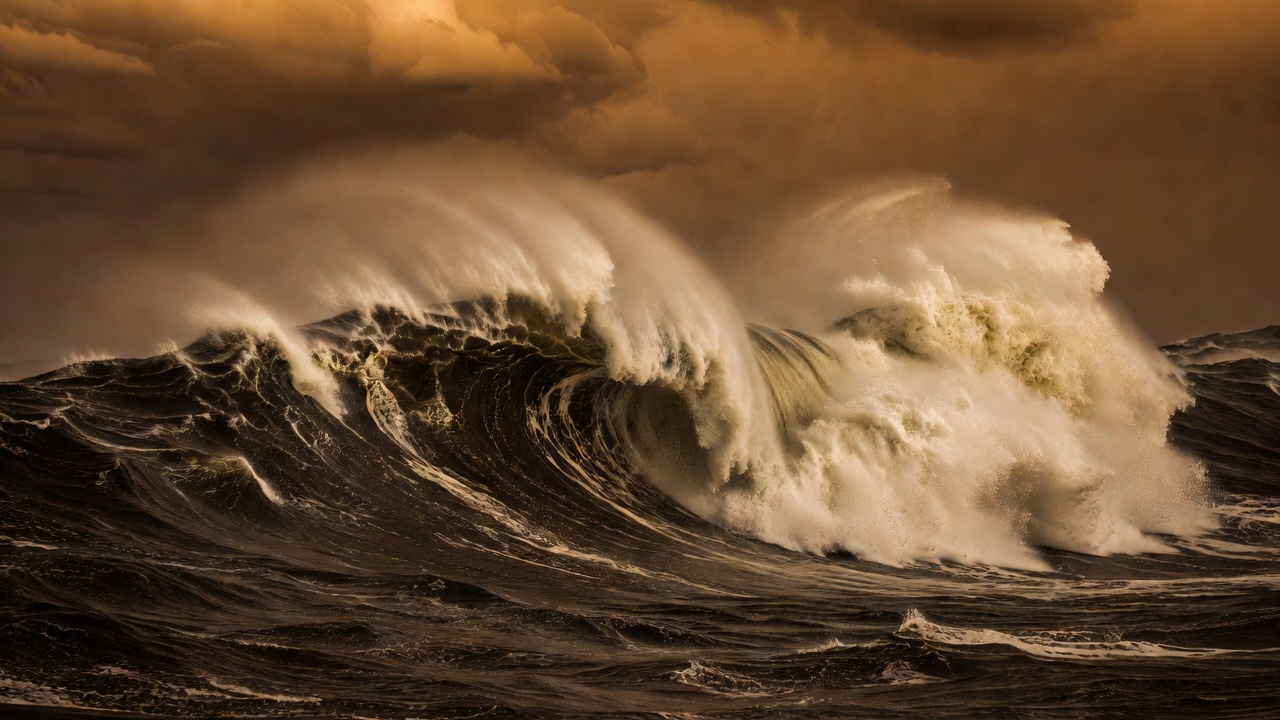
Begin with the water under a wave
From the beach, a wave looks like a moving wall of water. Farther offshore, the motion is subtler. Water particles beneath an unbroken wave move in approximately orbital paths, while the wave’s energy travels onward. A floating object may bob, drift with currents and slowly move through wave-related drift; it does not simply travel with each crest across an entire ocean.
This distinction helps explain why a distant storm can send surf to a coast without sending the same water there. It also has limits. Once a wave breaks, turbulent water rushes toward shore and must return through the surf zone. That moving water is central to understanding currents and should not be mistaken for harmless up-and-down motion.
Wind gives the surface energy
Small ripples make the surface rough enough for wind to transfer energy more effectively. Three useful ingredients are wind speed, how long the wind blows, and fetch: the distance of open water over which it acts in a broadly consistent direction. Strong wind over a tiny patch of water does not produce the same sea as a large, long-lasting storm.
Near a storm, waves can be steep, irregular and mixed together. This is often called wind sea. Waves that travel beyond their generating winds become swell. The distinction is useful rather than absolute: a coast can receive distant swell and locally generated wind waves at the same time.
Height and period describe different things
Wave height is measured from trough to crest. Period is the time between successive crests passing a point. A forecast may show peak period, associated with the strongest part of the wave-energy spectrum, or another period measure. Those values are not interchangeable, so check the provider’s definition.
For a similar offshore height, longer-period waves generally carry more energy and feel the seabed at greater depths. This can produce powerful breaking surf on an exposed coast, but there is no universal conversion from period to beach wave height. Depth, direction, shelter and underwater topography all matter.
| Swell example | What changes | What stays uncertain |
|---|---|---|
| 1 m at 6 s | Shorter spacing and typically less energy than the longer-period example. | Actual breaking size and local currents. |
| 1 m at 14 s | Longer spacing and greater potential for energetic surf. | How the beach’s exposure and seabed transform it. |
Why swell arrives in groups
A storm produces a range of wave frequencies. In deep water, longer-period wave groups travel faster than shorter-period groups, so the swell can become more organized with distance. Individual crests also move through their groups. That is one reason the ocean can appear rhythmic without behaving like a perfect metronome.
At the beach, several larger waves may arrive together as a set, followed by a lull. A few quiet minutes are not evidence that the largest waves have passed. Interactions between different swell components can make the sequence irregular. Avoid treating a single observed wave, or a short pause, as representative of the whole session.
The seabed changes the wave
As waves enter shallower water, their speed changes. They may bend through refraction, turn around obstacles through diffraction, and change height through shoaling. Energy can become concentrated over some underwater features and spread out over others. This helps explain why nearby beaches can respond very differently to the same offshore swell.
Eventually, a wave becomes too steep to remain stable. Gently sloping bottoms often encourage spilling breakers; more abrupt depth changes can produce plunging waves. These are broad patterns, not reliable beach classifications. Sandbars move, tides alter depth, and a familiar location can behave differently after a storm.
Turn the science into better questions
Instead of asking only “How big is it?”, ask where the swell came from, which period is being reported, and whether the beach faces that direction. Then ask what local wind and water level are doing. You are building an explanation of observed conditions, not obtaining permission to enter the water.
For further reading, NOAA Ocean Service’s explanation of ocean waves introduces wind, energy transfer and other wave sources. Tsunamis have different causes and behaviour from the ordinary wind-generated surf discussed here.